
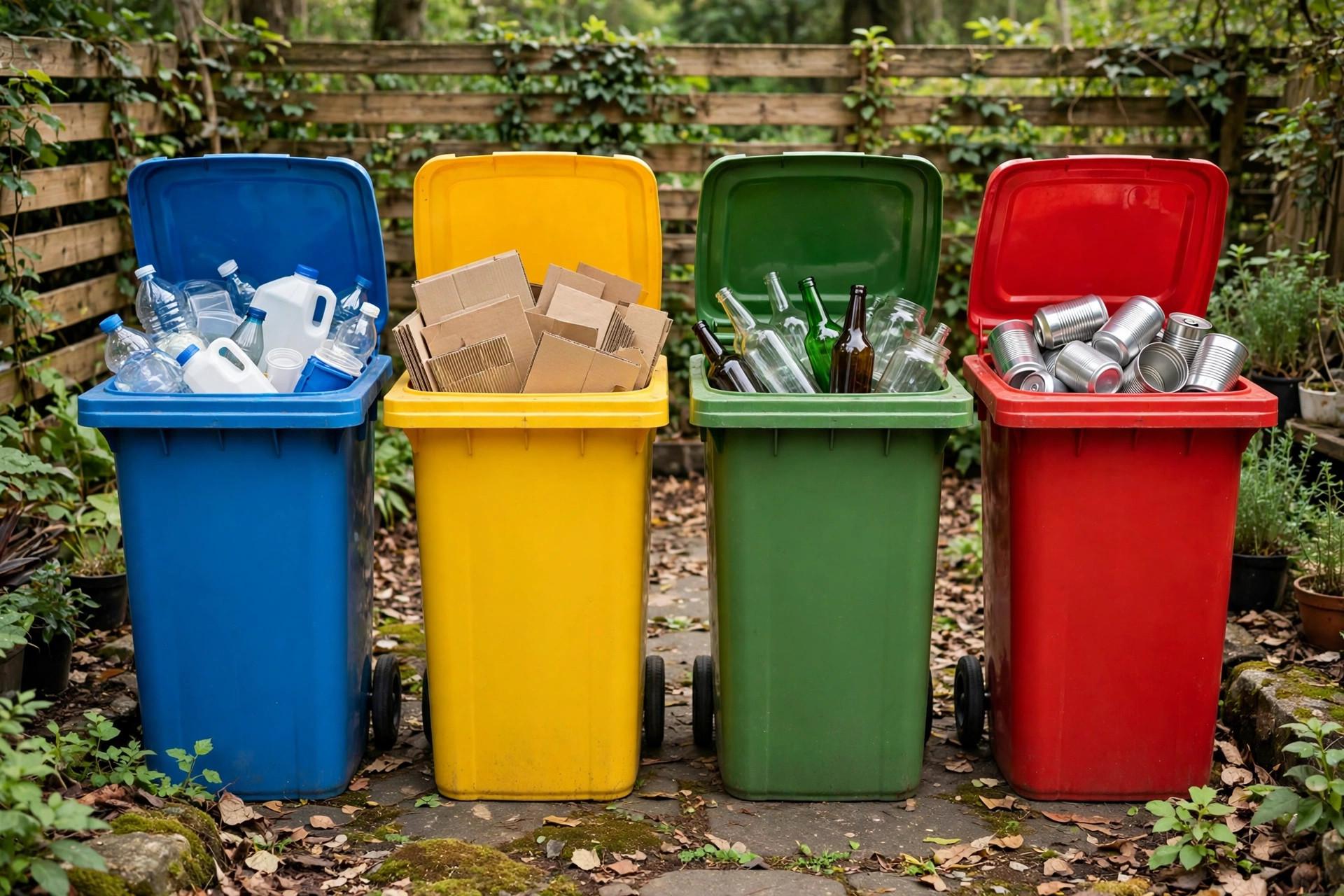
Most of us interact with recycling for about ten seconds: toss, close lid, done. But your bin is only the first step in an industrial chain — and understanding that chain explains almost every confusing recycling rule you will ever meet. This guide walks through how recycling actually works, what belongs in the bin, what ruins the batch, and how to handle the tricky stuff.
How Recycling Actually Works
Recycling is not magic; it is a three-stage manufacturing process. Knowing the stages is the key to every rule below.
Step 1: Collection
Your recyclables are picked up at the curb or dropped at collection points, often all mixed together — known as single-stream recycling — for convenience. Single-stream boosts participation but also contamination: one greasy box or bag of trash can spoil a whole load. Some places still use multi-stream or sorted collection, which produces cleaner material at the cost of a little more effort from residents.
Step 2: Sorting
Everything goes to a Materials Recovery Facility (MRF, pronounced "murf"), where the mixed stream is split back apart. Magnets pull out steel, eddy currents fling out aluminum, optical sorters identify plastics by type, screens separate paper from containers, and people hand-pick what the machines miss. This is why shape and cleanliness matter: items that are too small fall through the screens, and food-soiled paper cannot be separated from clean fiber.
Step 3: Reprocessing
Sorted materials are baled and sold to reprocessors, who turn them into new products: paper is pulped, glass is crushed into cullet and remelted, metals are shredded and smelted, and plastics are washed, flaked, and pelletized. Here is the uncomfortable truth the whole system rests on: recycling only happens if someone buys the recycled material. When markets are strong, your bottle becomes a new bottle; when they are weak, even perfectly sorted material can sit unsold. Putting the right things in the bin — clean and dry — is how you keep your end of the bargain.
What You Can Recycle: The Usual Suspects
Rules vary by city (more on that later), but these materials are accepted in most curbside programs across the US, UK, Canada, and Australia.
Paper and cardboard
Newspapers, magazines, office paper, junk mail, cereal boxes, and corrugated cardboard all recycle well. Keep them dry and reasonably clean — a clean pizza-box lid is fine; the greasy bottom is not. Flatten boxes to save space in your bin and in the collection truck.
Glass bottles and jars
Food and drink containers in any color. Rinse out residue, and follow local guidance on lids — rules differ by area. Glass can be remelted into new containers without loss of quality, which makes it one of the most straightforward materials to recycle.
Metal cans, tins, and foil
Aluminum drink cans, steel food tins, and clean aluminum foil and trays. Metals are among the most valuable recyclables: recycling aluminum uses a fraction of the energy of making it from raw ore, so cans are worth the rinse. Give them a quick wash, and crush them to save space where your program allows.
Plastics #1 and #2
Bottle-shaped plastics marked PET (#1, such as drink bottles) and HDPE (#2, such as milk jugs and detergent bottles) are the most widely accepted plastics and the most reliably reprocessed. Empty them, give them a rinse, and reattach the cap if your program says so — loose caps are often too small for sorting equipment. Other numbers (#3–#7) are accepted in some places and not others; never assume the chasing-arrows symbol alone means your city takes it.
What Contaminates Recycling: Keep These Out
Contamination is the recycling industry's expensive headache: the wrong items jam machinery, spoil good material, and can send entire truckloads to landfill. These are the usual offenders.
- Greasy pizza boxes and food-soiled paper. Oil cannot be separated from paper fibers during pulping, so the batch is ruined. Tear off the clean lid to recycle, and bin or compost the greasy part.
- Plastic bags and film. They tangle in sorting machinery — workers call them "tanglers" — forcing shutdowns to cut them out. Return clean bags to supermarket collection points instead.
- Disposable coffee cups. Most are paper lined with plastic film, which standard paper mills cannot separate. Few curbside programs accept them; a reusable cup is the real fix.
- Styrofoam and polystyrene packaging. Light, bulky, and rarely economical to reprocess curbside; check for dedicated drop-off points.
- Shredded paper. The strips fall straight through sorting screens. Bag shredding in a paper bag or compost it if your program allows.
- Ceramics, mirrors, and window glass. Different melting points contaminate glass furnaces. Donate or dispose of these separately.
- Clothes, hoses, cords, and wires. Classic tanglers that wrap around equipment. Donate wearable textiles instead.
- Anything with food still in it, liquids, or hazardous residue. A quick rinse is the difference between a recyclable and a contaminant.
The golden rule against "wish-cycling" — tossing in questionable items and hoping for the best — is this: if you are not sure and cannot check quickly, it is usually better to leave it out. One wrong item can do more harm than one right item does good.
E-Waste and Batteries Need Special Handling
Never put batteries or electronics in your curbside bin. Lithium batteries crushed in collection trucks or at sorting facilities cause fires — a genuine and growing safety problem. E-waste is both hazardous (lead, mercury, flame retardants) and valuable (copper, gold, rare metals), so it deserves its own stream.
- Take batteries to dedicated collection points — many electronics shops, supermarkets, and municipal sites accept them free of charge.
- Use manufacturer or retailer take-back schemes for old phones, laptops, and appliances, and wipe personal data from devices first.
- Watch for periodic e-waste collection events run by your city or county.
- Donate or sell working devices — reuse beats recycling every time.
Composting Basics
Food scraps and yard waste are heavy and wet — and in landfill they generate methane, a potent greenhouse gas. Composting returns them to the soil instead, and it is simpler than its reputation suggests.
- What to compost: fruit and vegetable scraps, coffee grounds, eggshells, leaves, grass clippings, and plain cardboard.
- The basic recipe: mix nitrogen-rich "greens" (food scraps) with carbon-rich "browns" (dry leaves, shredded newspaper), keep the pile moist, and turn it occasionally.
- What to skip in a basic home pile: meat, dairy, oils, and pet waste — they attract pests and smell. Many municipal programs accept them because their facilities run hotter.
- No yard? Try a countertop bokashi bin or a worm farm, or check whether your city offers green-waste collection.
For a full walkthrough, see our home composting guide.
Your Local Rules Matter Most
Here is the part many guides bury: there is no single global recycling rulebook. What is accepted depends on your city's contract, its sorting facility's equipment, and which end-markets its materials go to — which is why your friend in another city can have completely different rules.
- Check your city or council website — most publish a clear "what goes where" list and update it when contracts change.
- Look for a recycling app or a QR code on your bin; many areas now offer a searchable "can I recycle this?" tool.
- When rules change they usually get stricter — recheck once a year rather than relying on old habits.
- Renting or new to the area? The previous tenant's habits are not a reliable guide.
Reduce and Reuse Before You Recycle
Recycling is the third R for a reason — it sits below reduce and reuse in the waste hierarchy. Reprocessing still uses energy, water, and transport, and not every material survives the loop equally well. The bin should be your last resort, not your first plan.
- Refuse what you do not need: carrier bags, freebies, excessive packaging.
- Choose reusables for the daily repeat offenders — water bottles, coffee cups, shopping bags, food containers.
- Buy recycled-content products to close the loop; demand for recycled material is what keeps the whole system funded.
- Repair, donate, and buy secondhand to keep goods in use for longer.
Get the big three in the right order and the bin nearly sorts itself. And if you are tackling your wider footprint too, our carbon footprint guide starts with the actions that matter most — or browse more in our environment section.