
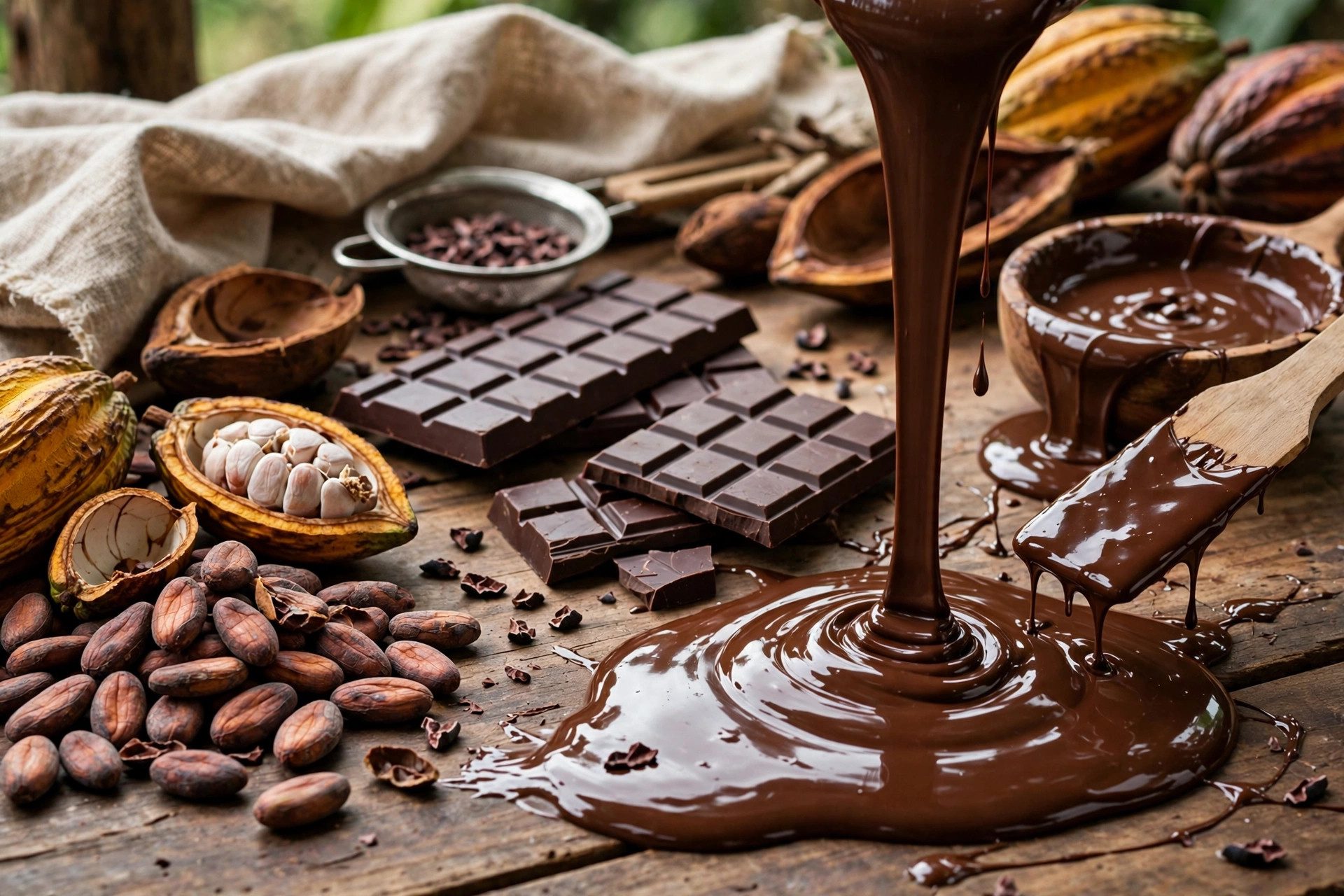
That chocolate bar in your hand began its life as a football-shaped tropical fruit growing on a tree near the equator. Between the cacao pod and the finished bar lies one of food's most fascinating transformations — involving fermentation, fire, and precise engineering. Most chocolate lovers have no idea how many steps, or how much human skill, stand between the tree and the wrapper.
This guide follows the complete journey, bean to bar, so you understand exactly what you are tasting — and why a $2 bar and a $12 bar can taste like entirely different foods.
It Starts With a Fruit: The Cacao Pod
Chocolate comes from Theobroma cacao — literally food of the gods — a small evergreen tree native to the Amazon basin and now grown in a belt around the equator, with West Africa producing about 70 percent of the world's supply. The tree produces large, ridged pods directly from its trunk and branches, each containing 20 to 60 seeds — the cacao beans — embedded in a sweet, white pulp.
Harvesting is still done by hand. Workers cut ripe pods open with machetes, scoop out the beans and pulp, and begin processing within days. Timing matters: the pulp starts fermenting naturally almost immediately, and that fermentation is the first critical step in developing chocolate flavor. At this stage, the beans taste nothing like chocolate — they are bitter, astringent, and raw.
Fermentation: Where Flavor Begins
Fresh beans are piled into wooden boxes or baskets, covered with banana leaves, and left to ferment for five to seven days. Naturally occurring yeasts and bacteria go to work in stages: first yeasts convert the pulp's sugars into alcohol, then bacteria convert the alcohol into acids. The pile heats up to around 50°C (122°F), and the beans are turned regularly for even fermentation.
This step is non-negotiable for good chocolate. Fermentation kills the bean's germ (preventing sprouting), breaks down bitter compounds, and creates the chemical precursors of chocolate flavor — hundreds of them. Under-fermented beans taste harsh and astringent; over-fermented beans taste rotten. Mastering fermentation is one of the great skills of cacao farming, and it is why single-origin chocolates can taste so distinctive. If you are curious about how microbes transform other foods too, see what fermentation is and how it works.
Drying and Sorting
After fermentation, beans are spread in the sun to dry for about a week, reducing moisture from around 60 percent to roughly 7 percent. Proper drying prevents mold during shipping and storage — a constant risk in tropical climates. Farmers turn the beans regularly and protect them from rain.
Dried beans — now stable, shippable, and faintly chocolatey in aroma — are bagged and sold. Much of the world's cacao passes through cooperatives and traders before reaching manufacturers, though the bean-to-bar movement has pushed more makers toward direct relationships with farmers.
Roasting: Developing the Flavor
At the chocolate factory, beans are cleaned, then roasted — typically 20 to 40 minutes at 120 to 140°C (250 to 285°F). Roasting is where chocolate flavor fully develops, through Maillard reactions between amino acids and sugars (the same chemistry behind seared steak and toasted bread).
Roast profile is a maker's signature decision. Lighter roasts preserve delicate fruity and floral notes of fine cacao; darker roasts produce the deep, robust flavor most people associate with chocolate. After roasting, the beans are cracked and winnowed — the papery shells blown away — leaving the nibs: the pure, crunchy heart of the bean. Nibs are already edible and are sold as a health food, tasting intensely of unsweetened chocolate.
Grinding, Conching, and Tempering
Nibs are ground — historically between granite stones, now in steel mills — into a thick paste called chocolate liquor (no alcohol involved; liquor here just means liquid). The grinding releases cocoa butter from the nibs' cells, turning the mass fluid. At this point, the maker decides the recipe: for dark chocolate, sugar and perhaps extra cocoa butter are added; for milk chocolate, milk powder joins the mix.
Then comes conching, invented in 1879 by Rodolphe Lindt. The chocolate is kneaded and aerated in a conche for hours or days. Conching drives off volatile acids, rounds out harsh flavors, and develops the smooth texture we expect. Cheap chocolate may be conched for a few hours; fine chocolate for 72 hours or more.
Finally, tempering: the chocolate is carefully heated, cooled, and reheated to form the right cocoa butter crystals (Form V, for the technically minded). Proper tempering gives chocolate its glossy finish, satisfying snap, and resistance to melting on your fingers. Poorly tempered chocolate looks dull and streaky — a defect called bloom. Explore more food science in our Food category.
Dark, Milk, and White: What's the Difference?
- Dark chocolate contains chocolate liquor, cocoa butter, and sugar — no milk. Cocoa content typically ranges from 50 to 100 percent. Higher percentages taste more intense and less sweet.
- Milk chocolate adds milk powder or condensed milk, making it creamier, sweeter, and milder. It was pioneered in Switzerland in the 1870s and remains the world's best-selling type.
- White chocolate contains cocoa butter, sugar, and milk — but no chocolate liquor, so it has no cocoa solids. Purists debate whether it counts as chocolate at all, but legally it does in most countries (with minimum cocoa butter requirements).
Labels like single origin (beans from one region) and cacao percentage (the share of the bar from the cacao bean versus sugar and milk) are your best guides to what is inside.
Chocolate and Health: What Science Says
Dark chocolate — particularly varieties above 70 percent cacao — contains flavanols, antioxidants associated in studies with improved blood flow, modest blood pressure reductions, and better endothelial function. It also provides iron, magnesium, and theobromine, a gentle stimulant.
The caveats matter: most studies use high-flavanol chocolate or cocoa, not typical candy bars, and commercial chocolate often carries significant sugar and calories. Dutch processing (alkalization), common in mass-market cocoa, destroys many flavanols. So a small portion of high-quality dark chocolate can be part of a healthy diet — but chocolate is not medicine, and milk chocolate candy is mostly sugar.
From a hand-cut pod in Ghana or Ecuador to the bar in your pantry, chocolate passes through fermentation, drying, roasting, grinding, conching, and tempering — each step shaping the final flavor. The next time you taste a truly great bar, you will know exactly how much craft went into it.