
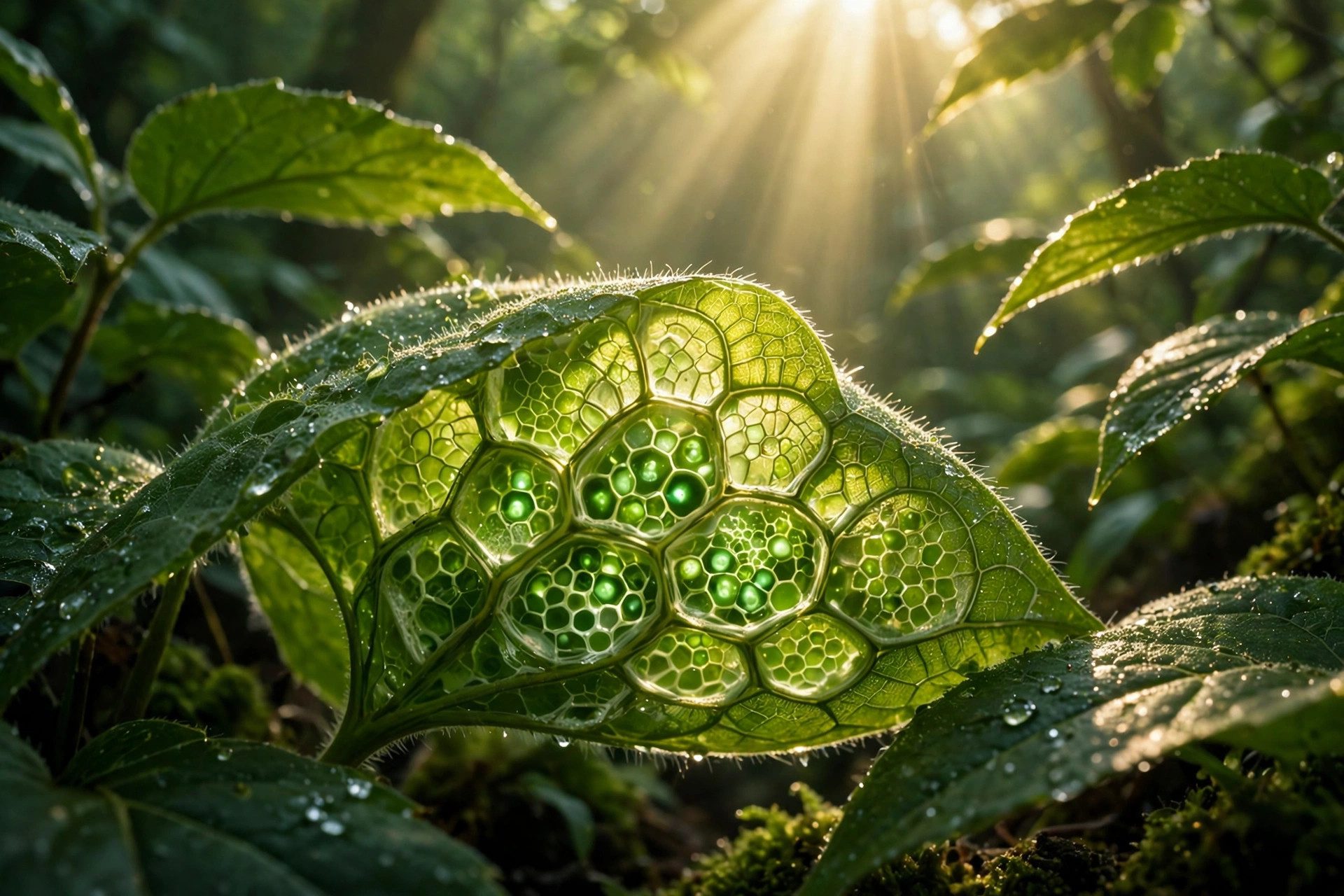
Photosynthesis is the process by which green plants, algae and some bacteria convert light energy into chemical energy. In simple terms, it is how plants make their own food — and, as a by-product, produce most of the oxygen we breathe.
If you have ever wondered how a tiny seed becomes a towering tree using nothing but sunlight, air and water, the answer is photosynthesis. It is arguably the most important chemical process on Earth: almost every meal you eat and every breath you take traces back to it. This guide explains how it works, step by step — from the leaf you can see down to the molecular machinery inside each cell — along with the factors that speed it up or slow it down, and why scientists are now trying to copy it.
The basic equation
The overall process can be summarized in a single chemical equation: carbon dioxide plus water, powered by light energy, becomes glucose (a sugar) plus oxygen. Written in chemical symbols, it looks like this: 6CO2 + 6H2O + light energy → C6H12O6 + 6O2.
The glucose serves as food for the plant. Some of it is burned immediately for energy, some is converted into starch for storage, and some becomes cellulose — the tough fibre that builds stems, trunks and leaves. The oxygen is released into the air through tiny pores in the leaves called stomata.
Where it happens: the chloroplast
In plant cells, photosynthesis takes place inside chloroplasts — small structures that contain a green pigment called chlorophyll. Chlorophyll absorbs light, mostly in the red and blue parts of the spectrum, which is why plants appear green: green light is reflected rather than absorbed.
A chloroplast is a marvel of packaging. It has an outer and inner membrane, and inside, stacks of disc-like membranes called thylakoids (piled into structures called grana) surrounded by a fluid called the stroma. The light-capturing reactions happen on the thylakoid membranes, while the sugar-building reactions happen in the stroma. Plants also carry helper pigments called carotenoids, which capture extra wavelengths of light — and which become visible as yellow and orange colours in autumn, when trees break down their chlorophyll before shedding leaves.
The two main stages
Photosynthesis happens in two connected stages. The light-dependent reactions capture energy from sunlight and temporarily store it in energy-carrying molecules, splitting water molecules and releasing oxygen in the process. The Calvin cycle (light-independent reactions) then uses that stored energy to assemble carbon dioxide into glucose. The second stage does not need darkness — it simply does not require light directly.
Stage 1: the light-dependent reactions
These reactions take place on the thylakoid membranes and need light directly. Here is the sequence:
- Photosystem II absorbs light. Chlorophyll molecules capture photons, energizing electrons to a high-energy state.
- Water is split. To replace the lost electrons, the plant splits water molecules — a step called photolysis. This releases oxygen as a by-product. Remarkably, the oxygen you are breathing right now came from water, not from carbon dioxide.
- An electron transport chain builds a gradient. The energized electrons travel through a chain of proteins that pump hydrogen ions across the thylakoid membrane, storing energy like water behind a dam.
- ATP is made. The ions flow back through an enzyme called ATP synthase, which manufactures ATP — the cell's rechargeable energy battery.
- Photosystem I re-energizes electrons with a second hit of light, and the electrons are finally used to make NADPH, a second energy carrier.
The net products of stage 1 are ATP, NADPH and oxygen. The first two power stage 2; the oxygen drifts out of the leaf.
Stage 2: the Calvin cycle
The Calvin cycle runs in the stroma and builds sugar in three phases:
- Carbon fixation: an enzyme called Rubisco — often described as the most abundant protein on Earth — attaches carbon dioxide to a five-carbon molecule called RuBP.
- Reduction: ATP and NADPH from stage 1 supply energy to convert the resulting compound into G3P, a three-carbon sugar building block.
- Regeneration: most of the G3P is recycled to rebuild RuBP so the cycle can continue; the rest exits to make glucose and other carbohydrates.
It takes six turns of the cycle — six carbon dioxide molecules — to assemble a single glucose molecule. Because the cycle depends on the ATP and NADPH made in stage 1, it effectively runs during the day even though light does not strike it directly.
Not all plants do it the same way: C3, C4 and CAM
Most plants use the standard pathway described above, called C3 photosynthesis. But in hot or dry climates, some plants evolved clever variations that reduce water loss and a wasteful side-reaction called photorespiration, where Rubisco accidentally grabs oxygen instead of carbon dioxide.
| Type | Examples | Key adaptation | Suited to |
|---|---|---|---|
| C3 | Wheat, rice, soybeans, most trees | Standard Calvin cycle in all green cells | Temperate, mild climates |
| C4 | Maize (corn), sugarcane, sorghum | Carbon is first fixed in outer cells, then the Calvin cycle runs in sheltered inner cells | Hot, bright climates |
| CAM | Cacti, pineapples, succulents | Stomata open at night to capture CO2, stored as acid until daylight | Deserts and very dry regions |
What affects the rate of photosynthesis
Four main factors control how fast a plant photosynthesizes:
- Light intensity: more light means a faster rate, up to a saturation point beyond which extra light makes no difference.
- Carbon dioxide concentration: more CO2 in the air speeds the Calvin cycle — commercial greenhouses sometimes enrich their air with CO2 for this reason.
- Temperature: the enzymes involved work best in a moderate range; too cold and reactions crawl, too hot and enzymes lose their shape.
- Water availability: when water is scarce, plants close their stomata to avoid drying out — but closed stomata also block CO2 from entering, slowing photosynthesis.
Whichever factor is in shortest supply caps the whole process. Biologists call this the limiting factor principle: like a barrel made of unequal staves, the shortest stave sets how much water the barrel can hold.
Photosynthesis and respiration: a two-way partnership
Photosynthesis has a near-mirror image: cellular respiration, the process by which living things — plants included — break down glucose with oxygen to release usable energy. Its equation is essentially photosynthesis in reverse: glucose + oxygen → carbon dioxide + water + energy (ATP).
Plants do both. They photosynthesize when light is available and respire around the clock. That is why a plant sealed in a dark container eventually dies: without light, photosynthesis stops, but respiration keeps consuming the plant's stored sugars until they run out.
How photosynthesis transformed the planet
Early Earth had almost no free oxygen. Then, more than two billion years ago, cyanobacteria — sometimes called blue-green algae — evolved oxygen-releasing photosynthesis. Over hundreds of millions of years, their waste product accumulated in the atmosphere in an event scientists call the Great Oxidation Event.
This was one of the most consequential changes in Earth's history. Oxygen enabled far more efficient respiration, eventually powering complex animals. High in the atmosphere, oxygen formed the ozone layer, which blocks harmful ultraviolet radiation and allowed life to colonize land. And over geological time, vast quantities of buried plant matter were transformed into coal, oil and natural gas — the fossil fuels that powered the industrial age. To understand how that ancient carbon cycle connects to today's climate, see our guide on what climate change is.
Photosynthesis, farming and the future
Human civilization runs on photosynthesis: every crop harvest is captured sunlight converted into food. Plant breeders have spent a century selecting varieties that photosynthesize more efficiently, and researchers are now going further — trying to engineer C4-style efficiency into rice, or redesign Rubisco to waste less energy on photorespiration. These remain active research programmes, not finished technologies.
Meanwhile, scientists are pursuing artificial photosynthesis: devices that use sunlight to split water into hydrogen fuel or convert CO2 into useful chemicals, mimicking leaves without the plant. Like solar panels, which also harvest sunlight but produce electricity instead of sugar, the goal is clean energy — except here the output would be storable fuel. If you want to shrink your own footprint while the science catches up, our guide to reducing your carbon footprint has practical steps.
Common misconceptions
- "Plants get their food from the soil." Soil provides water and minerals, but the bulk of a plant's dry mass — its carbon — comes from carbon dioxide in the air. In the 1600s, Jan Baptist van Helmont grew a willow tree for five years and found it gained far more mass than the soil lost, an early clue that plants build themselves mostly from air and water.
- "Only leaves photosynthesize." Any green tissue containing chlorophyll can do it, including young green stems.
- "Plants don't breathe." They do — through the same stomata, taking in oxygen for respiration, especially at night.
- "The oxygen comes from carbon dioxide." Experiments with labelled atoms showed the released oxygen comes from the splitting of water in the light reactions.
From a single leaf to the planet's atmosphere, photosynthesis links sunlight to nearly all life. It feeds us, fills our lungs, and — through ancient buried forests — even fuelled the modern world. Understanding it is key to understanding biology, agriculture and climate science, and it remains one of the most inspiring processes for scientists trying to build a sustainable future. (Curious how microbes transform food without sunlight? Read about fermentation.)